

The Ghost in the Machine: Why Your Wrench Can’t Find the Soul
Most of us got into horses because of a ghost.

Not the rattling-chains kind, but the 6D essence of a creature that seems to move between worlds. We’ve all had that one moment—maybe it lasted three seconds, maybe three minutes—where the world went quiet, the dimensions expanded, and you weren’t “riding a horse” anymore. You were two spirits occupying the same coordinate in space-time.
It is often breathtaking, almost shocking, because the sensory experience shifts so violently from the mundane to the infinite. It’s the feeling of the fuzzy hair on the back of an ear, the rhythmic cadence of a hoof-beat that seems to pulse inside your own chest, and the smell of sun-warmed dust that suddenly feels like home. In those moments, there is no “ask” and no “answer.” There is only a shared orbit. It is bliss. It is the 6D Soul Connection. It is the state of True Unity where horse and human are let down, turned loose, powerful and at peace—where we almost become one thing.
And then, that moment vanishes.
The rest of our horsemanship journey can become a desperate, lifelong chase to find that ghost again using a 2D mechanical wrench. We spend decades trying to fix a spiritual “leak” by tightening the carburetor of our mechanics.
The Great Adult De-fragmentation
This isn’t just about the arena; it’s about the “Grown-Up” condition. Somewhere between childhood and the first mortgage, we don’t lose our citizenship in the higher dimensions—we just lose the awareness that we are citizens. We are taught that to be successful, we must master the 2D. We become experts at managing the “Loom”—the linear lists of “If/Then” that define our careers, our marriages, and the complex, often exhausting choreography of raising children and navigating the family holidays.
We all know the feeling of a holiday that lacks “the spirit.” We try to solve it with 2D tools: buying fancier Christmas presents or decorating more elaborately. But no matter how expensive the gift, it can’t manufacture the feeling of true connection. A stack of boxes under a tree is just “mass management”; it isn’t the magic.
But at our core, we are designed to be in harmony with the universe. When we lose that connection, we feel a hollow, aching gap. We reach for hedonistic band-aids—too much sugar, another glass of wine, or the dopamine hit of a screen—trying to drown out the static of a life lived in low resolution.
Of course, the Horsemanship Pursuit has a funny way of cleaning up those habits. It’s hard to justify expensive vices when the hay bill is due, and you quickly realize that sitting the trot requires a level of core fitness that makes that extra donut look like a liability. The horse doesn’t just demand our attention; they demand our physical and financial sobriety.
The 2D Dead End and the Emotional Floor

When we bring this “Management Mindset” to the horse, we hit a wall. We have been taught that the map of horsemanship is flat, consisting of two primary tools: Negative Reinforcement (pressure and release) and Positive Reinforcement (behavior capture).
If we stick to it long enough, we start to incorporate the Emotional Dimension. We realize that our consistency helps the horse’s emotional state—it makes them feel safe. But here is the trap: we are empathetic beings. We love our horses, we get excited, and sometimes we get depressed. We shouldn’t be “emotionless” robots, but we also can’t be reckless emotional beings. If we just “drop” our raw, unrefined emotions into the arena, we are just adding more static to the signal.
We have to learn to process our 3D and 4D baggage—the stress of the mortgage or a disagreement with a loved one—before we ask for a 6D connection. Sometimes, when we arrive at the barn as a “ball of emotions,” the 2D mechanics act as a Grounding Wire. They pull us out of our internal storm and back into the physical present. The mechanics aren’t the cage; they are the floor.
The Paradox of the Piano: Rhythm as the Carrier Wave
The reason we are often unhappy in our pursuit is that we’ve mistaken the floor for the ceiling. Think of horsemanship like playing a piano.
The 2D Mechanics are your Left Hand. The Left Hand plays the steady, rhythmic base chords. It holds the tempo, the key, and the structure. It’s the “alphabet.” The 6D Connection is your Right Hand. It’s the flying, intricate melody. It’s the spirit and the bliss.
The hardest part of the piano is getting the two hands to work together. This is where we look for that feeling of “Hooking On.” In music, rhythm isn’t just a rule—it’s the energy field that allows the melody to exist. When you establish a rhythmic cadence in your mechanics, you are effectively clearing the static. A horse’s nervous system thrives on predictability. When our horse hooks on to the rhythm of that Left Hand—whether it’s the first A-B-C of groundwork or the 1-2-3 of a transition—they aren’t just obeying; they are syncing.
If your “ask” has a steady beat, the horse can stop “managing the noise” of wondering what’s coming next and start “tuning into the signal.” It is the silence between the notes that enables it to be music in the first place. This is how we move from the “rattling chains” of a heavy, mechanical struggle into something that feels more like the glitter of fresh dew on the grass or the scent of a pine forest after a summer nap.

The Music Room: Guideposts of the Pursuit
Whether we are standing together in the Round Pen for a one-on-one lesson, riding in a clinic with other students, or exploring high-level theory together inside the Horsemanship Insider portal, we are always in the Music Room.
In these spaces, we have to focus on the mechanics. We are training the Left Hand to find the keys so that one day, the Right Hand can be free to play the symphony. Setting that technical floor is an act of devotion. We focus on the mechanics to ground ourselves and find that rhythm, because we cannot have a symphony without a steady pulse.
This blog is at the very edges of my ability to verbalize my personal horsemanship experience. The 6D soul connection isn’t something you build with a wrench; it’s something that emerges when we change ourselves enough to clear the 2D static. We are perfecting our 2D “skin” so the Spirit can finally inhabit it. We clear the static until the spirit isn’t a scary stranger, but a presence as light and inevitable as a sunset. We refine the work until the “Hook” isn’t a grip, but a shared heartbeat.
We have to stop trying to manage the mass in 2D. We have to allow ourselves to unfold into all six dimensions so that we can have more of those moments of true unity.
What’s Next in YOUR HORSEMANSHIP Pursuit?
Join the Conversation This blog is just one chapter of the story. Every week, we go into the weeds of these concepts on the Horsemanship Remarks show. I’d love to hear your thoughts—leave a comment below and tell me: what does the “Ghost” of your horse’s potential look like to you right now?
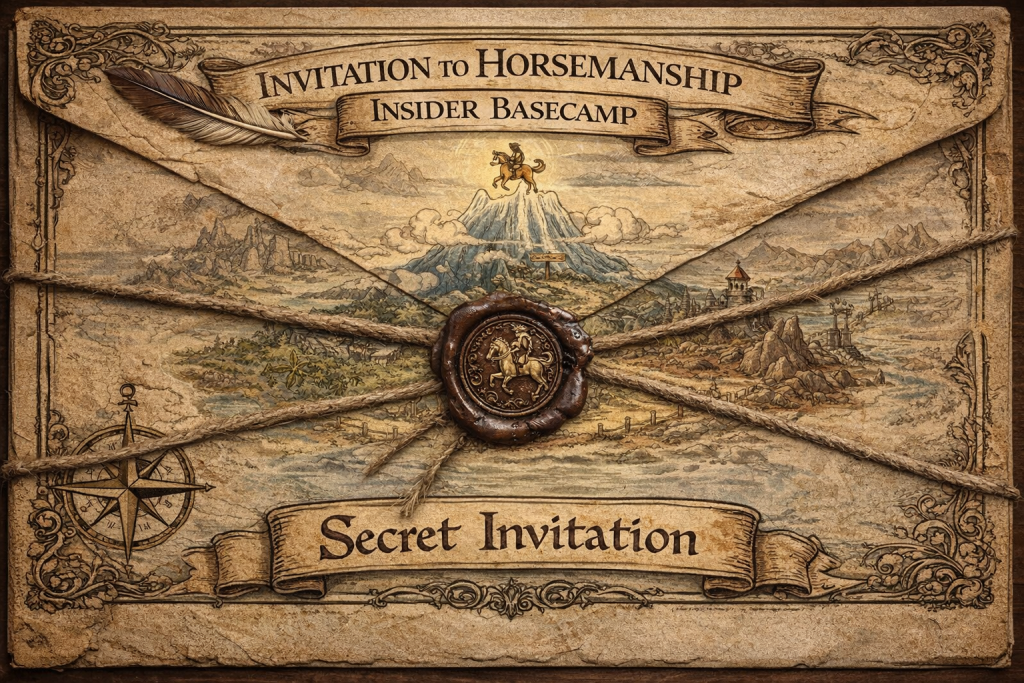
The Scholarly Path If you’re tired of being a spectator and want to start your own disciplined journey from green horse to Bridlehorse, I invite you to join us inside Horsemanship Insider. This is where we break down the mechanics, the mindset, and the “Source Code” behind the movement. I have a secret invitation for a week at Basecamp just for you: 🔑Key to Basecamp Here.
Your thoughts? No right or wrong answers or comments. first thoughts are great.
Thanks for being awesome! – Emma Daily Kline🦋
Leave a Reply