
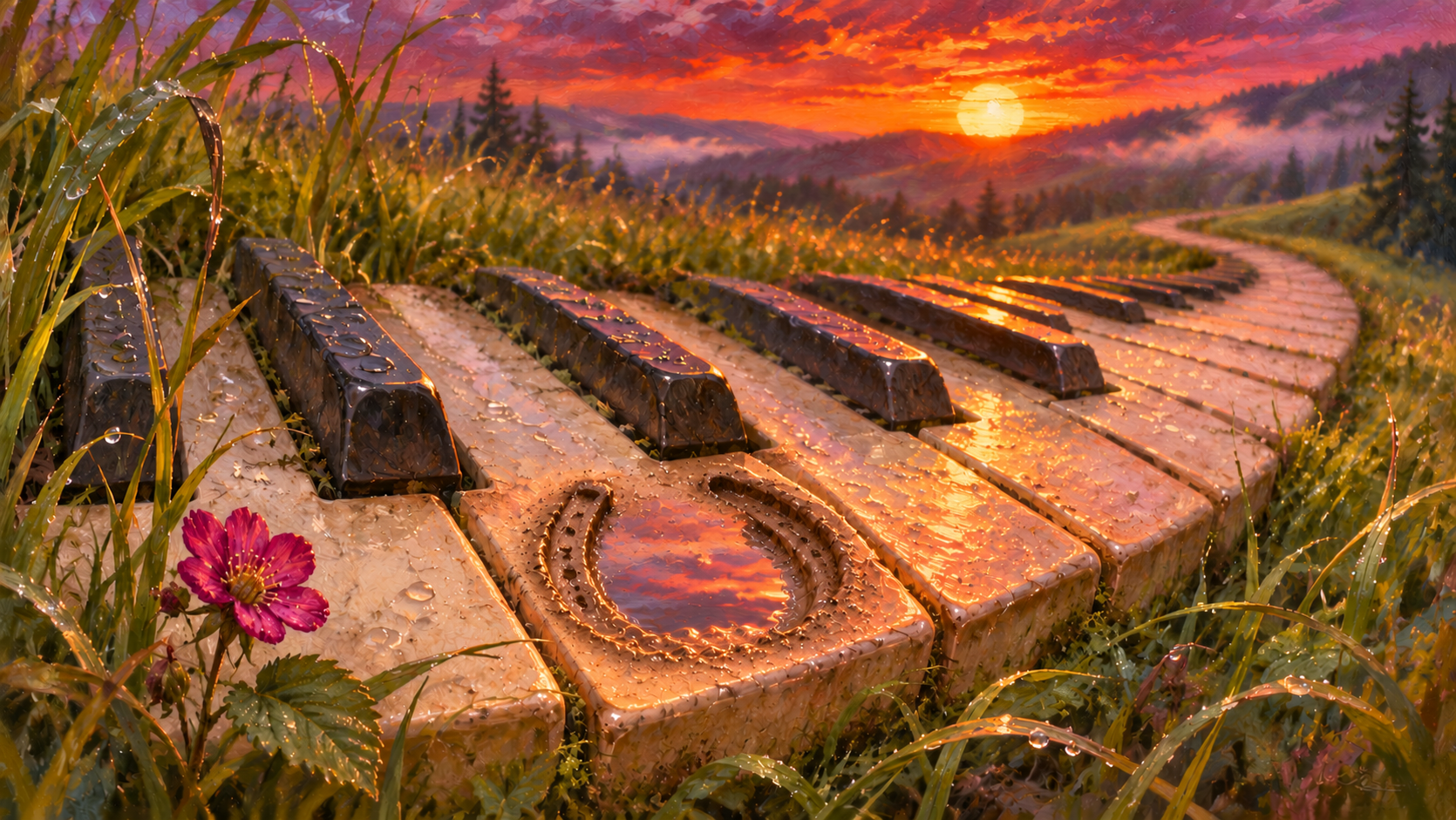
Middle C Is Middle C
…but the feeling gets there first, even if you don’t know it.
Sooner or later on the trail, it can look like the plan stopped working. It didn’t.
A horse is a horse. Four feet, a mammal, a prey animal, a herd animal (and beautiful). The footfalls are the footfalls. Walk, trot and canter are what they are. They need to learn when to relax and when to engage. That part doesn’t change. There’s usually an order to things, too. This puzzle, then that one.
It’s like a piano. Middle C is middle C. Most people learn the keys, the scales and the chords in order. A few genius players never do, and play by ear from the start. Either way, the notes stay put. What changes with practice is the smoothness between the notes. Someone who has played long enough can make up a melody that surprises everybody, and it still fits, because the notes fit.
What changes is what we can see.
When things get stuck, it’s tempting to think the program doesn’t work, or that this horse needs a different program. Usually that isn’t it. It’s perception: how much a person can actually perceive of where they are, what they’ve already made sense of, and where they’re stuck.
The mountain doesn’t move
Think of it as a mountain. The top is the top. The current trail goes where it goes. But what you can see changes with elevation. Down low, you see the next few steps. Higher up, you can see how the trail bends, where the steep parts are, and how far you’ve come.
Switchbacks
Some stretches of trail are switchbacks. A hundred yards this way, a hundred yards that way. From below, it can look like going nowhere. It isn’t. It’s climbing.
Learning usually goes like that for a horse. Some things click super quickly. Some need a lot more help, and sometimes the help comes from a seemingly unrelated place. You work on something sideways, and the stuck spot comes loose.
What changes is the horse: what they understand, how dialed in they are, how much they know to watch you. Sometimes a whole bunch clicks at once. Sometimes the stuck spot is something less obvious, maybe even a gesture we didn’t know we were making.
The scramble

Sometimes on a switchback you look up at the path right above you and think, I bet I can go there. Other times there’s nothing for it but the long way, back and forth.
The mountain hasn’t changed. The top is still the top. What changed is what you can see: the slope, the footing, how far it really is. Knowing when to scramble and when to take the long way is intuition. And it comes down to perception.
Still informed, just fast
Intuition isn’t the absence of knowing. It’s what knowledge turns into after enough years. Thousands of small observations pile up. A hind foot that didn’t quite step evenly. An ear that stayed back a half second too long. A horse holding their breath. After a while they don’t need to be looked up anymore. They arrive all at once, as a feeling.
The good news for anyone just starting: you don’t have to see the whole mountain yet. The trail does that work for you while your eye grows.
When you’re stuck
None of this means sitting there doing nothing when it isn’t working. Intuition isn’t something you force. It’s something you slip into without really noticing, and it’s usually not a drag at all.
Being totally stuck is the sign you’ve stepped out of it. That’s the time to go back to the basics and comb through them with a fine-tooth comb. Are the Five Principles working? Are the eight puzzles working? It’s like a hiker checking the pack. Am I out of snacks? Out of rope? Do I need a new pair of socks?
That’s usually where the answers are.
The teacher’s part
Teaching horsemanship means spending a lot of time taking things apart. Principles, mechanics, puzzles with answers, steps people can take home and try. Words are just words until they pass through the filter of experience, and a clear map helps people go get the experience.
The map doesn’t change either. What changes is how much of the ground you can read. Same mountain. Same top.
Sometimes the horse knows first
Sometimes the horse has already noticed something we haven’t.
If you’re too married to your own story about what’s happening, it’s easy to miss what your horse is showing you.
Sometimes we just don’t know what the horse is telling us. Waiting around isn’t the answer, and neither is pushing ahead bullheadedly. Sleep on it, think on it, and go back to the scaffolding. That’s the beauty of it: the scaffolding will get you there.
That sits right next to Friends First. A friend gets listened to, even when what they’re saying doesn’t make sense yet. And it sits right next to You Have Unlimited Guesses. Our horses get them, and so do we. A scramble that doesn’t work out is just one more guess. You go back to the trail and try again.
Lately one mare in particular has been asking me to trust this more than any horse in years.
The mountain doesn’t move. With enough miles, you just see more of it.
More from this trail: Horsemanship Intuition: Learning to Trust Your Spidey Sense and The 30-Hour Emergency: What Flower Taught Me About Trusting My Gut.